
Your Local Dentist for Dental Bridges in Austin & Georgetown, TX
Related Posts



.jpg)

If you have a missing tooth, you know the daily frustrations it can cause. It might make chewing your favorite meals difficult or make you feel self-conscious when you smile. Here in Austin and Georgetown, we see many patients who are looking for a solution. A gap in your smile is more than just a cosmetic issue; it affects your confidence and your overall oral health.
As a trusted local dentist serving Austin, Georgetown, and nearby communities like Cedar Park and Round Rock, we are here to guide you toward a reliable, beautiful solution. Let's explore what a dental bridge is and how this restorative dentistry service can bring your full, healthy smile back to life.
Your Guide to a Complete Smile in Austin and Georgetown, TX
Losing a tooth can start a chain reaction of dental problems. The empty space can make eating uncomfortable, and over time, it may cause the surrounding teeth to shift out of place. This can lead to issues with your bite and even jaw pain. At 3D Dental, our patients in Austin and Georgetown trust us to address these problems before they worsen.
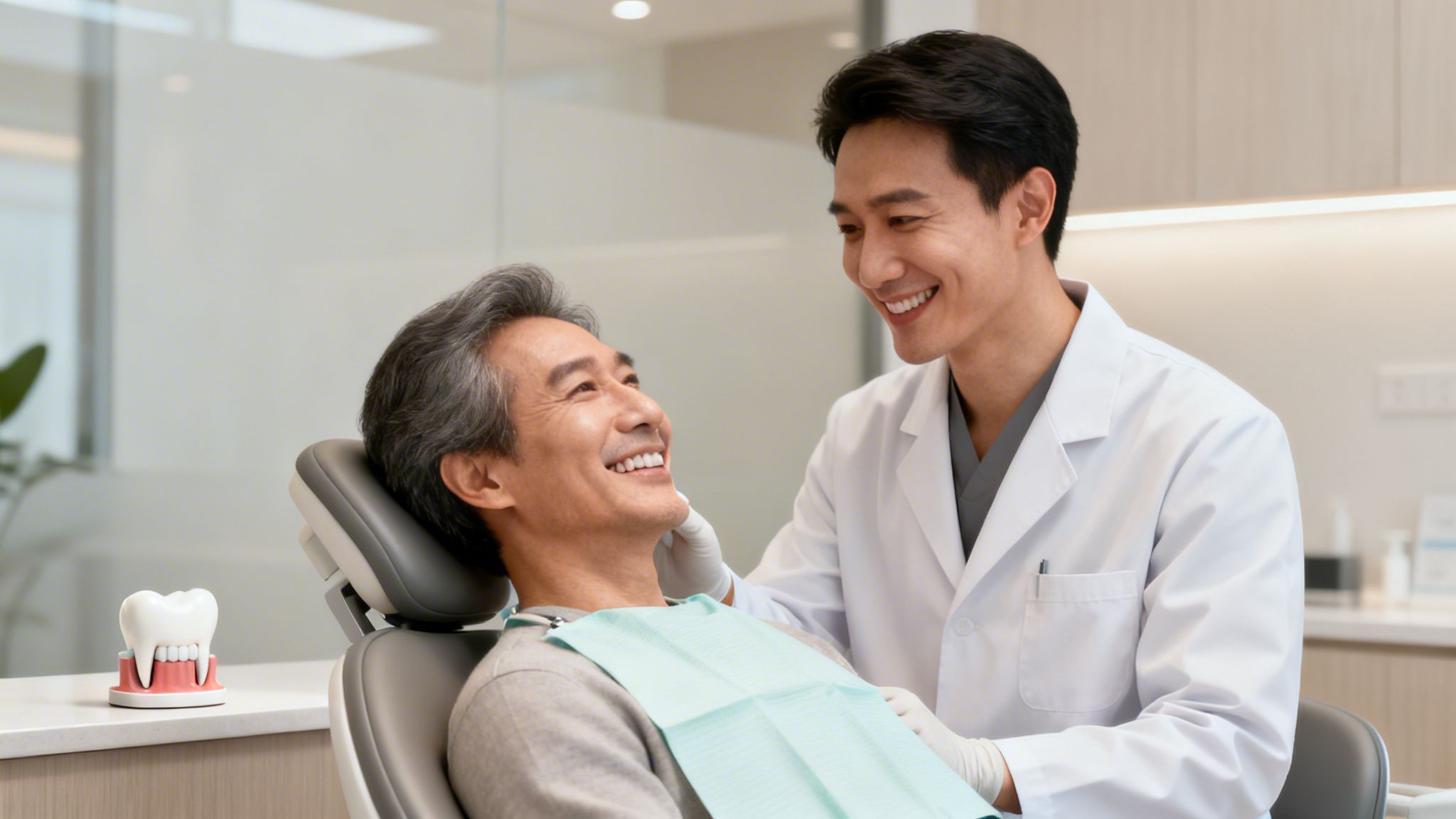
So, what is the best way to fix it? A dental bridge is a custom-made restoration that literally "bridges the gap" left by a missing tooth or teeth. It is a fixed solution, meaning it stays in place permanently, using the neighboring teeth as anchors to support a new, artificial tooth in the middle. It's a common and effective part of both restorative and cosmetic dentistry.
To help you understand, let's break down the components of a dental bridge.
Quick Answer: A Dental Bridge at a Glance
Understanding the core components of a dental bridge and their roles in restoring your smile.
Together, these components create a seamless, sturdy restoration that blends right in with your natural smile.
Restoring Smiles in Your Community
As your local cosmetic dentist in Austin, TX, we know a healthy, complete smile is priceless. A dental bridge is an excellent restorative dentistry solution that delivers some major benefits:
- Brings Back Your Bite: You’ll be able to chew and speak with confidence again, without any awkwardness or discomfort.
- Holds the Line: It prevents adjacent teeth from drifting into the empty space, which is a common cause of future bite problems and TMJ pain.
- Maintains Your Face Shape: A bridge supports your lips and cheeks, preventing that sunken look that often comes with tooth loss.
- Spreads the Workload: It helps distribute bite forces evenly across your teeth, protecting them from excessive wear and tear.
Our practice is proud to serve the communities of North Austin, Georgetown, Cedar Park, and Round Rock. We specialize in crafting beautiful, durable dental bridges that look and feel completely natural.
Your Local Partner for Modern Dental Care
Whether you’re searching for a "dentist near me" for a routine check-up or need a more involved solution like a bridge or dental implants, 3D Dental is your partner in achieving great oral health. We’ve built our practice on trust, clear communication, and a philosophy that always puts you, the patient, first.
At 3D Dental, our approach combines advanced 3D technology with an in-house lab, ensuring your new smile is not only stunning but also perfectly tailored to you. We're your local partners in regaining a confident, healthy smile.
From your initial new patient exam to the final placement of your restoration, our teams in Austin and Georgetown are here to provide reassuring, professional care every step of the way. We are dedicated to helping our neighbors in Wells Branch and Liberty Hill find relief from dental pain and rediscover the life-changing benefits of a healthy, bright smile.
How a Dental Bridge Rebuilds Your Smile
So, what is a dental bridge, and how does it actually work? Imagine a real-world bridge spanning a river—it needs solid support on both banks to be stable. A dental bridge functions in almost the exact same way, just on a much smaller, more precise scale inside your mouth.
When you lose a tooth, it leaves a noticeable gap. A dental bridge is a custom-made restoration designed specifically to fill that space with an artificial tooth, bringing back both the look and function of a full smile. It’s a trusted and highly effective solution in modern restorative dentistry for our patients in Austin and Georgetown.
The Core Components of a Bridge
At its heart, a dental bridge has three key parts that work together as a single unit. Understanding these pieces helps clarify how this elegant solution can completely rebuild your bite.
- The Pontic: This is the star of the show—the artificial tooth that "bridges" the empty space. We meticulously design it to look, feel, and chew just like your original tooth.
- The Abutments: These are the healthy, natural teeth on either side of the gap. Think of them as the strong support pillars holding up the entire bridge structure.
- The Crowns: To lock the bridge into place, we fit custom-made crowns over the abutment teeth. These crowns are then permanently fused to the pontic, creating one solid, seamless piece.
This design allows the pontic to sit securely in the gap, drawing strength and stability from the healthy teeth next to it.
More Than Just Filling a Space
The main goal of a dental bridge goes far beyond just fixing a cosmetic issue. It’s about restoring your ability to chew and speak with confidence while also protecting the overall health of your mouth. When a tooth is missing for too long, the neighboring teeth naturally start to drift and tilt into the empty space.
This shifting can throw your entire bite out of alignment, which can kick off a cascade of other problems. We’re talking about excessive wear on other teeth, jaw pain (TMJ issues), and even long-term changes to your facial structure. By holding that space open, a dental bridge prevents all of this from happening.
At 3D Dental, our goal is to create a restoration that not only looks indistinguishable from your natural teeth but also restores the delicate balance of your bite, protecting your long-term oral health.
Materials That Mimic Nature
For our patients looking for a top cosmetic dentist in Austin or Georgetown, we know the final appearance is every bit as important as the function. That's why we only use advanced materials selected for their incredible strength and surprisingly lifelike appearance.
At 3D Dental, we craft our bridges from high-tech materials like zirconia and porcelain. These are renowned for their durability and their uncanny ability to mimic the subtle translucency and color variations of natural tooth enamel. Because we have our own in-house lab, we can custom-shade and shape your bridge with an artist's touch, ensuring your new smile is both strong and beautifully seamless. From your initial dental x-rays to the final fitting, we manage every detail to get a perfect result for our patients in Cedar Park, Round Rock, and the greater Austin area.
Choosing The Right Type of Dental Bridge
Deciding to restore your smile with a dental bridge is a fantastic first step, but it’s not a one-size-fits-all solution. The best type of bridge for you depends on a few key factors, like where the missing tooth is located and the health of the teeth around it.
At 3D Dental, our teams in North Austin and Georgetown are here to walk you through all your options. We want you to feel confident and fully informed about the decision you’re making for your long-term oral health. During your consultation, we'll carefully assess your unique situation to recommend the ideal type of bridge. We consider everything from your bite forces to the final aesthetics to make sure your new smile is both beautiful and built to last.
Traditional Dental Bridges
The traditional dental bridge is the most common for a reason—it’s a reliable, time-tested workhorse of restorative dentistry. Think of it as the classic design: an artificial tooth, called a pontic, is fused between two dental crowns. Those crowns are then fitted over the healthy teeth on either side of the gap.
This structure is incredibly stable and is an excellent choice for replacing molars, which handle serious chewing forces. The only catch is that you need strong, healthy teeth on both sides of the gap to act as sturdy anchors, or abutments. If you need a dependable restoration almost anywhere in your mouth, a traditional bridge is often the go-to recommendation.
Cantilever Bridges
But what if you only have a healthy tooth on one side of the gap? This is where a cantilever bridge comes in. Instead of being supported by two crowns, the pontic is anchored by just a single crown on the adjacent tooth.
It works a bit like a balcony that's supported by a strong connection to a building on just one side. This approach is more conservative since it only requires us to alter one neighboring tooth. However, because all the force is placed on that single anchor tooth, we typically only recommend it for areas with lower bite pressure, like your front teeth.
This flowchart shows the basic structure of how a standard bridge works.
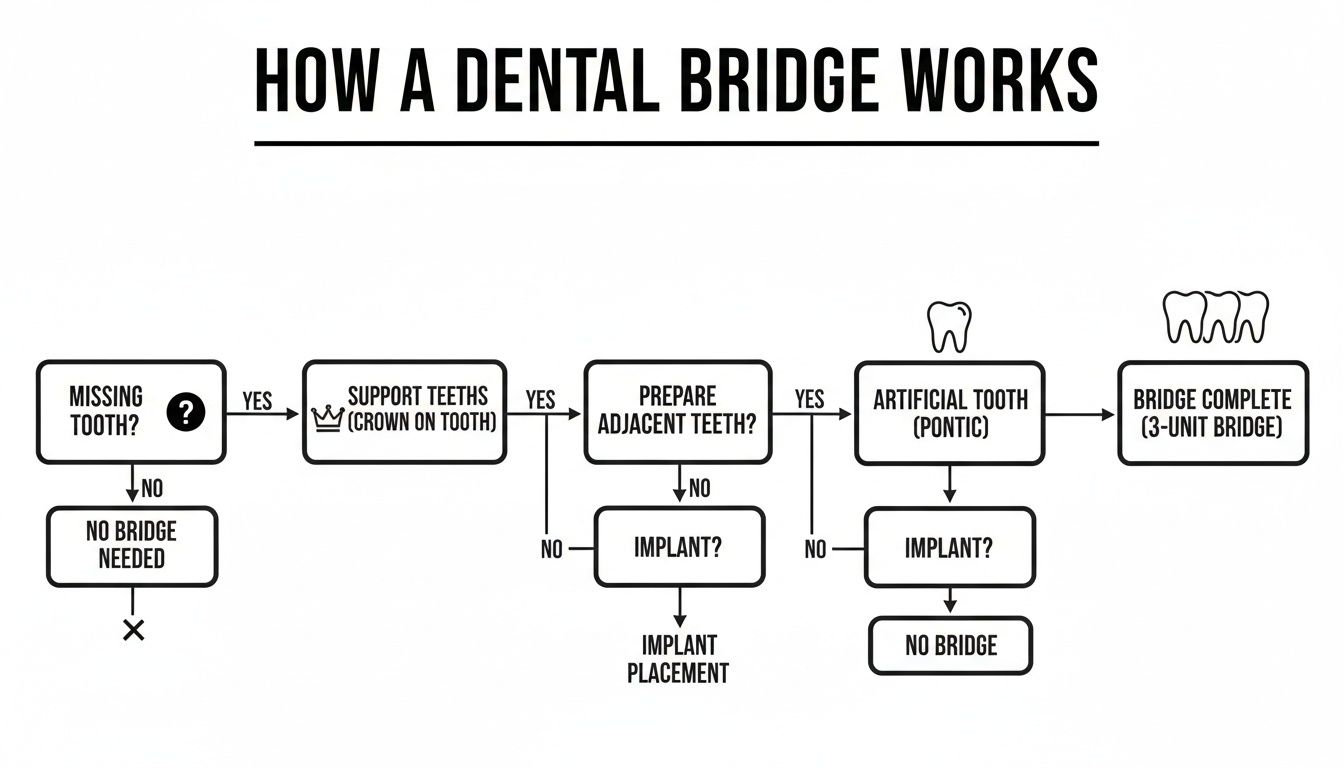
As you can see, the pontic fills the gap while the abutment crowns provide robust support, seamlessly completing your smile.
Maryland Bridges
For missing front teeth, a Maryland bridge offers an even more conservative alternative. Instead of placing full crowns on the neighboring teeth, a Maryland bridge uses a small metal or porcelain framework that's bonded to the back of these teeth. This framework has little "wings" that securely hold the pontic in place.
The biggest benefit is that it requires minimal to no alteration of the healthy adjacent teeth. This makes it an appealing option for patients in Austin who want a less invasive solution. The bond isn’t quite as strong as a traditional bridge, so it's best suited for replacing single front teeth that don’t endure heavy chewing.
Implant-Supported Bridges
For the ultimate in stability and longevity, the implant-supported bridge stands out as the premium choice. This type of bridge is perfect if you’re missing several teeth in a row or if your natural teeth just aren't strong enough to support a traditional bridge.
Instead of relying on natural teeth for support, this bridge is anchored directly to dental implants—biocompatible titanium posts that are surgically placed into the jawbone. These implants act like artificial tooth roots, providing an exceptionally strong and stable foundation.
This method completely avoids the need to alter healthy teeth and helps preserve your jawbone, preventing the bone loss that naturally occurs after a tooth is lost. While the process is more involved, an implant-supported bridge offers unparalleled durability and function. For anyone looking for "dental implants near me" in Austin, this is a top-tier solution.
For anyone considering this advanced option, we've put together a complete guide on how dental implants can rebuild your smile.
Dental Bridge vs Dental Implant: A Comparison for Austin Patients
When replacing a single missing tooth, the two most common solutions are a traditional bridge and a dental implant. Each has its own set of pros and cons, and the right choice depends on your specific health needs, budget, and long-term goals.
To help clarify the differences, here’s a straightforward comparison:
Ultimately, choosing between a bridge and an implant is a major decision. A bridge can be a faster, more affordable way to restore your smile, while an implant offers a more durable, long-term solution that also protects your jawbone. Our dentists in Austin and Georgetown will help you make the best choice for your unique smile.
Your Dental Bridge Journey at 3D Dental
So, you’re thinking about a dental bridge. It’s a big decision, and we want you to feel completely confident and comfortable with the entire process. At our North Austin and Georgetown offices, we’ve taken the guesswork out of restoring your smile by blending advanced technology with a personal, patient-focused touch.
Here’s a straightforward look at what you can expect when you come to 3D Dental for a dental bridge.
Step 1: Your Initial Consultation and Exam
Everything starts with a conversation. Your first visit is all about us understanding your goals, answering your questions, and figuring out if a dental bridge is truly the best fit for you. We kick things off with a comprehensive new patient exam, but we do things a little differently.
We use our advanced 3D CT imaging to get a complete, detailed picture of your teeth, roots, and jawbone. This technology goes far beyond what a standard x-ray can show, letting us see the precise health of the teeth we’d use as anchors. This level of detail is absolutely critical for making sure your bridge has a solid foundation that will last for years.
Step 2: Tooth Preparation
Once we’ve agreed that a bridge is the right way to go, your next appointment will focus on preparing the abutment teeth—the ones that will hold the bridge in place. This involves gently reshaping a small amount of enamel on these teeth to make room for the crowns that will secure your new bridge.
Your comfort is always our top priority. We’ll use a local anesthetic to make sure the area is completely numb, so the whole process is painless. We work carefully to preserve as much of your healthy tooth structure as we can while creating the ideal fit.
Step 3: Digital Impressions and Custom Design
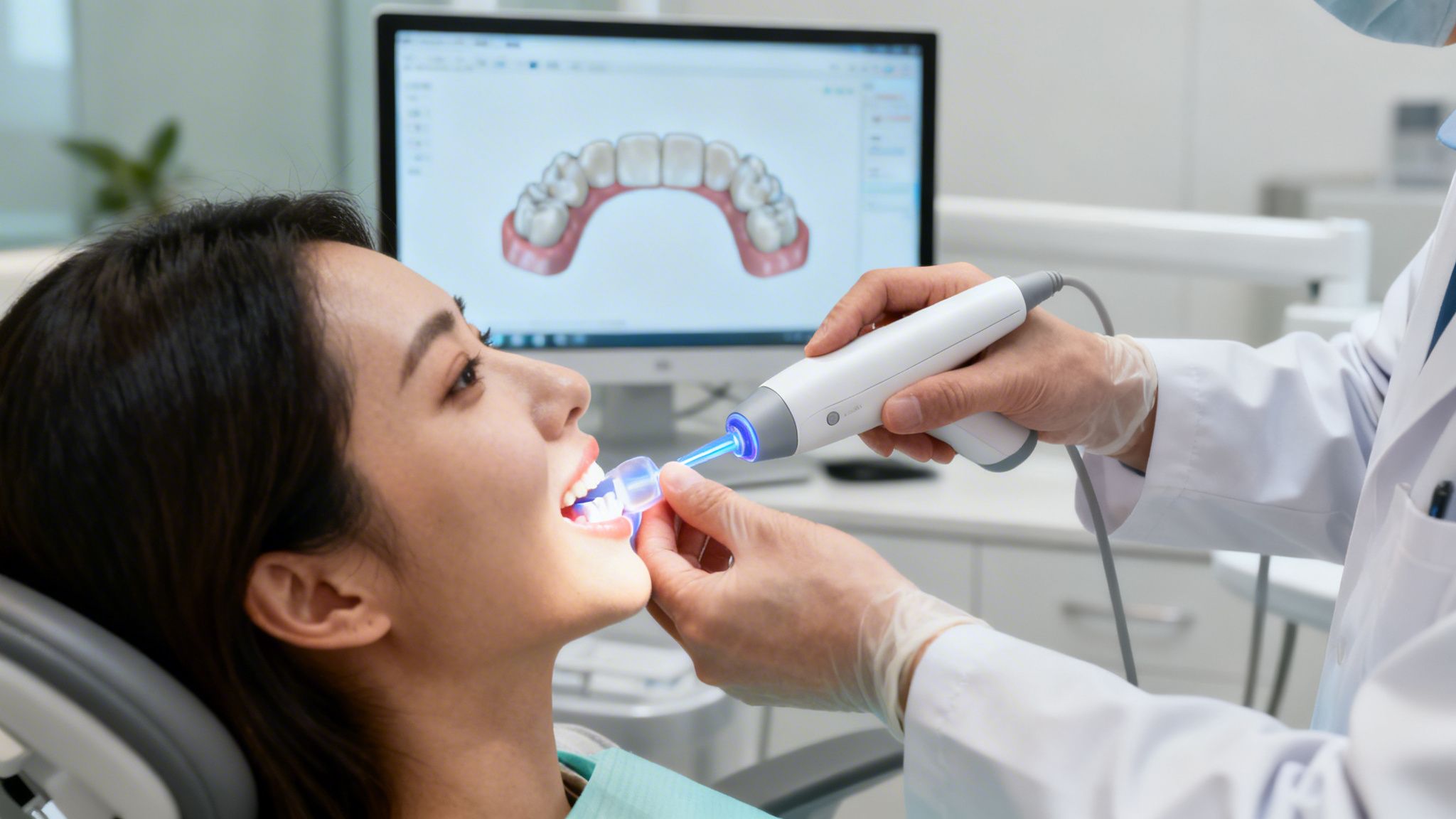
This is where our technology really makes a difference for our patients in Austin and Georgetown. Forget about those goopy, uncomfortable putty molds you might remember from the past. Instead, we use a sleek intraoral digital scanner. This small wand captures thousands of images per second, creating an incredibly accurate 3D model of your mouth.
The benefits are immediate: it’s faster, way more comfortable, and gives us a level of precision that traditional methods just can’t match. That digital blueprint is then sent directly to our in-house lab, where our expert technicians start crafting your custom bridge.
Having our own lab gives us total control over the quality. We can obsess over the details, matching the shade and shape to your natural teeth to create a result that looks and feels completely seamless.
Step 4: Wearing a Temporary Bridge
You won't have to walk around with a gap in your smile while our lab works its magic. We’ll create and place a comfortable temporary bridge for you to wear right away.
This temporary fix does a few important jobs:
- It protects the prepared teeth and prevents sensitivity.
- It lets you eat and speak just like normal.
- It keeps your smile looking great.
It’s a simple solution that ensures your daily life isn’t interrupted while you wait for the final, permanent bridge.
Step 5: Your Final Fitting and Placement
This is the most exciting step—getting your new smile. At your final appointment, we'll remove the temporary bridge and have you try on your permanent one. We check every single detail with meticulous care.
We'll examine the fit to make sure it sits perfectly against your gums and neighboring teeth. Then, we’ll check your bite, ensuring everything feels natural and comfortable when you chew. Only when you and our team are 100% happy with the fit and appearance do we permanently bond the bridge into place. You’ll leave our Austin or Georgetown office that day with a fully restored, functional, and confident smile.
For a deeper dive into how we create these restorations, you can learn more about our advanced crowns and bridges process.
The Life-Changing Benefits of a Dental Bridge
Beyond just filling an empty space, a dental bridge can bring truly significant improvements to your everyday life. It’s a restoration that enhances how you look, feel, and function, day in and day out. Many of our patients in Austin and Georgetown are genuinely surprised by how profound the positive changes are once their smile is complete again.
The most immediate benefit is getting your full function back. You’ll be able to chew your favorite foods without a second thought and speak with renewed clarity. A bridge also provides crucial support for your lips and cheeks, which helps maintain your natural facial shape and prevents that sunken-in look that can happen with missing teeth.
Health and Confidence Restored
A dental bridge also plays a vital, protective role in your long-term oral health. By holding the line, it prevents the remaining teeth from drifting into the empty space. This shifting can cause serious bite problems, jaw pain, and put uneven, damaging wear on your other teeth.
Here are some of the key benefits our patients experience:
- Improved Chewing and Digestion: Being able to chew your food properly is the very first step in good digestion. A bridge restores your ability to eat a varied, nutritious diet comfortably.
- Clearer Speech: Gaps in your smile can cause whistling sounds or make it hard to pronounce certain words. Closing these gaps with a bridge lets you speak with confidence.
- Evenly Distributed Bite Force: By replacing the missing tooth, a bridge makes sure that chewing pressure is spread out evenly across all your teeth, protecting them from excessive stress and potential damage.
- Prevention of Tooth Movement: It acts as a placeholder, stopping adjacent teeth from tilting or drifting out of position, which preserves your natural bite alignment.
A Time-Tested Solution Modernized for Today
Dental bridges have a long and successful history, but today’s technology has made them better than ever. The journey from the 18th to the 20th century marked a huge leap in how good they looked and how long they lasted. Porcelain-fused-to-metal (PFM) bridges, introduced in the 1950s, became a gold standard, and by the 1990s, all-ceramic materials like zirconia offered even greater success. Current research shows that getting a bridge can cut the risk of decay in the neighboring teeth by 25% compared to just leaving a gap. You can explore the fascinating history of dental bridges and their modern success for more insight.
At 3D Dental, we take these advancements a step further. We integrate them with our own in-house 3D printing and digital scanning, which gives us a 99.9% fit accuracy right from the start and cuts down on adjustment time by 50%.
Perhaps the most powerful benefit is the renewed confidence our patients in Austin, Georgetown, and Liberty Hill feel. It’s about being able to laugh and smile freely again, without a second thought.
Ultimately, choosing a dental bridge is an investment in your overall well-being. It is a reliable, proven solution modernized with the best technology available to bring back your complete, beautiful smile. Whether you're in Wells Branch, Cedar Park, or Round Rock, our team is ready to help you experience these life-changing benefits.
How to Care for Your New Dental Bridge
A new dental bridge is a fantastic investment in your smile and health. When you take good care of it, you can expect it to serve you well for many years—often 10 to 15 years, or even longer. The great news is that protecting this new restoration is pretty straightforward. It mostly involves building on the good oral hygiene habits you already have.
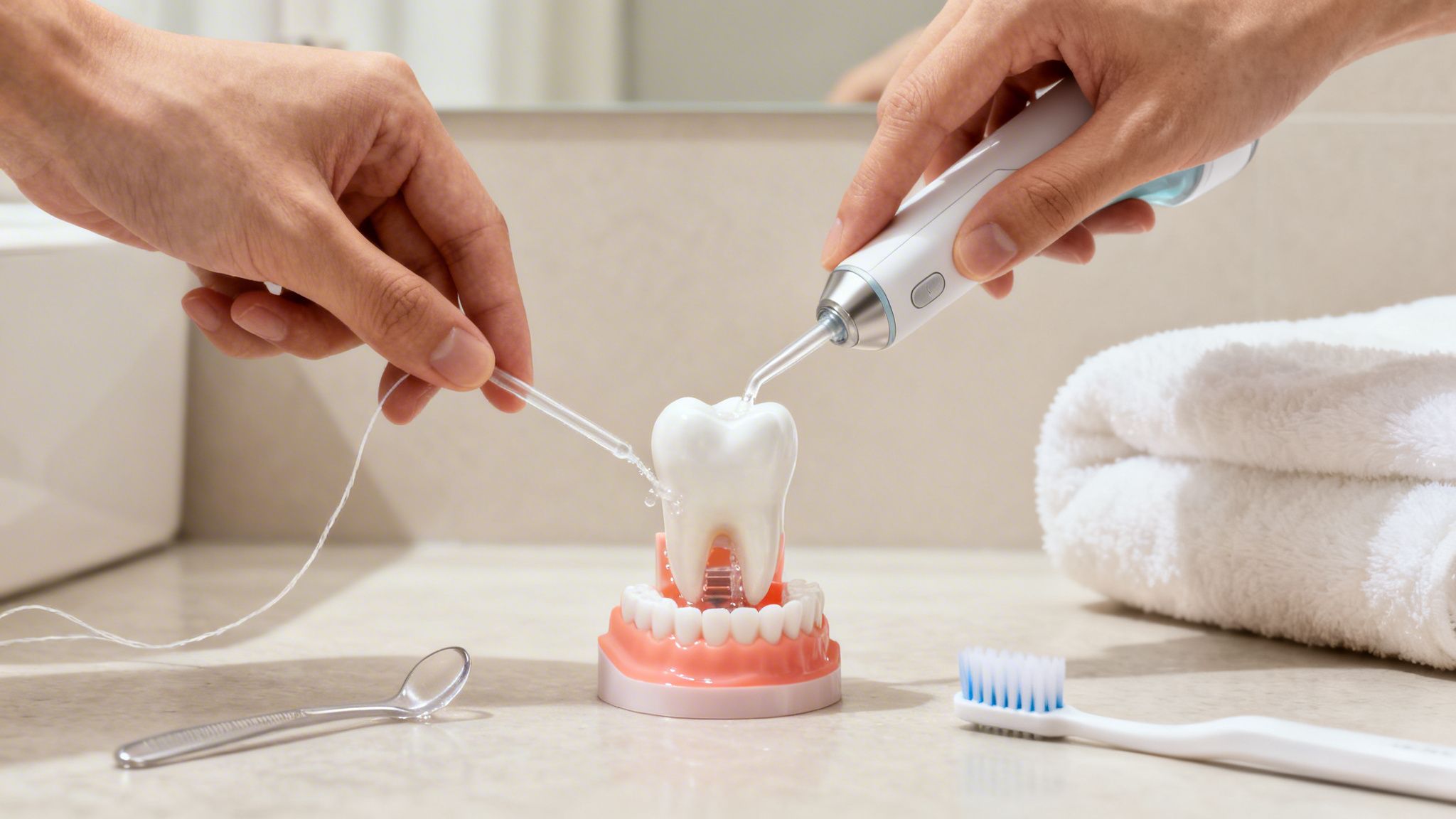
The foundation of good bridge care starts with the basics: brushing twice a day with a soft-bristled toothbrush and fluoride toothpaste. That’s no different from caring for your natural teeth. This simple step keeps the crowns and the pontic free from plaque and looking their best.
However, the most critical part of caring for your bridge is cleaning the area underneath the artificial tooth.
Cleaning Beneath the Bridge
Since the pontic (the false tooth) rests gently on your gums, it creates a small space where plaque and food particles can get trapped. If you don't clean it out, this can lead to gum inflammation, bad breath, and even decay in the supporting abutment teeth.
To get into that space effectively, you’ll need a few special tools. Our team at 3D Dental will show you exactly how to use them, but the most common options include:
- Floss Threaders: Think of these as flexible little plastic needles that help you guide a piece of dental floss under your bridge. Once it's through, you can gently slide the floss back and forth to clean along the gum line and the sides of the abutment teeth.
- Water Flossers (e.g., Waterpik): These devices are a game-changer for bridge maintenance. They use a targeted stream of pulsating water to flush out debris and plaque from those hard-to-reach areas, especially under the pontic. They are incredibly effective.
- Interdental Brushes: Also known as "proxy brushes," these tiny, specialized brushes are perfect for cleaning the space between the pontic and your gums.
Maintaining excellent oral hygiene around your dental bridge isn't just about protecting the restoration itself; it's about safeguarding the health of the anchor teeth that provide its essential support.
Foods to Approach with Caution
While our modern bridges made from materials like zirconia are incredibly strong, they aren’t indestructible. It’s smart to be a little mindful of what you eat to avoid accidentally damaging your new restoration.
We recommend you avoid or limit:
- Extremely Hard Foods: Biting down on things like hard candies, ice cubes, or un-popped popcorn kernels can put too much pressure on the bridge and potentially cause a fracture.
- Very Sticky Foods: Chewy candies like caramels or taffy can grab onto the bridge and, in some cases, loosen the cement that holds it in place.
- Using Your Teeth as Tools: This is a big one. Never use your bridge (or your natural teeth, for that matter!) to open packages, bite your nails, or do anything other than chew food.
The Importance of Regular Dental Visits
Finally, the single most important thing you can do for the long-term health of your bridge is to keep up with your regular dental care appointments at our Austin or Georgetown practice. These routine cleaning and exams are absolutely essential.
During these visits, our team will professionally clean your bridge and the surrounding teeth, and we'll check the health of your gums. We also use dental x-rays to look at the condition of the abutment teeth underneath the crowns, making sure they remain strong and free of decay. These check-ups allow us to spot any potential issues early on, long before they turn into serious problems.
By following this simple routine, you can ensure your dental bridge continues to support a healthy, functional, and brilliant smile for years to come.
Common Questions About Dental Bridges
It's completely normal to have questions when you're thinking about a new dental treatment. Making a smart decision about your smile is a big deal, and our team is here to give you clear, straightforward answers.
We've put together some of the most common questions we hear from our patients across the Austin and Georgetown area. Think of it as a starting point to help you feel confident and informed.
How Much Does a Dental Bridge Cost in Austin, TX?
The cost of a dental bridge really depends on a few key factors. The materials we use (like porcelain or ultra-strong zirconia), the type of bridge you need (is it a traditional bridge or one supported by implants?), and how many teeth you’re replacing all play a role. A simple traditional bridge, for example, will have a different price tag than a more complex implant-supported one.
At 3D Dental, we believe high-quality dental care should be within reach. During your consultation, we'll give you a detailed, transparent breakdown of all the costs—no surprises. We accept a wide range of dental insurance plans and also offer flexible payment solutions, including in-house plans and third-party financing with Cherry and Sunbit, to help everything fit into your budget.
Is Getting a Dental Bridge a Painful Procedure?
Your comfort is our top priority, period. The actual procedure for getting a dental bridge should not be painful at all. We use a powerful local anesthetic to completely numb the area before we begin preparing the anchor teeth, so you won’t feel any discomfort during the treatment.
It’s pretty common to feel some mild sensitivity or tenderness in your gums and teeth for a few days afterward. This can happen right after we place the temporary bridge and again when your permanent one is fitted. This feeling is temporary and can be easily managed with over-the-counter pain relievers. Our teams in Austin and Georgetown are absolutely dedicated to making your visit as stress-free as it can be.
A well-made dental bridge should feel completely natural and comfortable. If you notice any lasting pain, it's really important to give us a call. It could be a sign that we need to adjust your bite or the fit of the bridge.
How Long Will My Dental Bridge Last?
With great oral hygiene and regular professional check-ups, a high-quality bridge can last for many years. Most patients can expect 10 to 15 years of service, and sometimes even longer. The real key to its longevity is the health of the supporting teeth and the surrounding gums.
Because we use premium, durable materials like zirconia and craft your bridge in our own in-house lab, we can ensure a precise fit from the very start. This gives your restoration the best possible foundation for a long life. The best way to maximize its lifespan is to keep up with regular check-ups and cleanings at our Austin or Georgetown practice.
Are Dental Bridges a Good Option for Front Teeth?
Absolutely. Dental bridges are an excellent cosmetic solution for replacing missing front teeth. Restoring a front tooth is where the artistry of dentistry really comes into play—it has to look perfect. This is where our team's expertise truly shines.
We use beautiful, life-like materials such as all-porcelain or zirconia, which are custom-shaded to flawlessly match the color, shape, and even the subtle translucency of your natural teeth. For front teeth, a Maryland bridge is often a fantastic, conservative choice because it requires minimal changes to the neighboring teeth. Our goal is to create a restoration that blends in so seamlessly, no one will ever know it’s not your original tooth.
Ready to bridge the gap in your smile and get your confidence back? The team at 3D Dental is here to provide expert, patient-focused care in Austin and Georgetown, TX. Schedule your consultation today and take the first step toward a complete, healthy smile.
Ready to get started?
Schedule a free, no obligation consultation with our team and see what's possible for your smile!
Georgetown
- Mon-Thurs8:30am-5pm
- Fri8am-3:30pm
- Sat-SunClosed
Austin
- Mon-Tues8am-5pm
- Wed-Thurs9am-6pmFri8am-2pm
- Sat-SunClosed